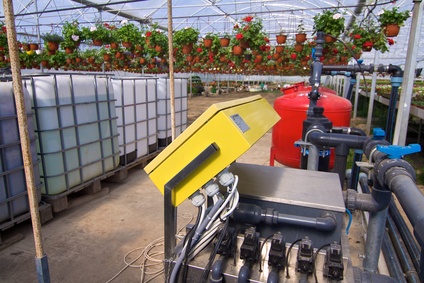
Proportioner systems Open hydroponic systems lend themselves to two different automation systems i.e. proportioner and injector systems. First let look at what a proportioner does. A proportioner can either be electrical or mechanical device that adds liquid, coming from a tank or other source, into a main line in specific ratio’s. For instance, the ratio [...]
The word ‘chelate’ is derived from the Greek word meaning ‘claw’. Many of the micro elements such as Fe, Mn, Cu and Zn are difficult for the plant to absorb and in some cases, deficiency symptoms may occur if these micro-elements are not made available to the plant in chelated form. A chelate is a [...]
Great care should be taken when working with chemicals. It is important to adhere to the following guidelines, which can be applied to all types of chemicals: Always keep the same type of chemical together. Always close the containers properly. Never leave any container open so that the gasses can escape. Place a brick or [...]
Most automated systems installed in closed hydroponic systems use injectors rather than proportioners. A simplified diagram of where to install such a system is provided below. Many advanced injectors such as the Priva® and Volmatic® systems use much more complex configurations. Most of the systems use two pH probes and two EC probes in case [...]
To make a nutrient stock solution, you need a minimum of two tanks. Nutrient Stock solutions cannot be made in one tank. The reason is that above a certain concentration, calcium reacts with sulphates and phosphates to form insoluble calcium sulphate ([latex]\ce{CaSO4}[/latex]) and calcium phosphate ([latex]\ce{Ca3(PO4)2}[/latex]). The two nutrient tanks will be called Tank A and [...]
Fertilizer solubility is one of the key elements in making hydroponic nutrient stock solutions. If you know the fertilizer solubility, you can make optimum stock solutions for any size nutrient tank. Making stock solutions is extremely simple. All you have to do is to calculate the amount of fertilizers required to make a normal 1:1 [...]
Micro nutrients are just as important as macro nutrients. Many growers fail to have their water analysed for all elements, and in some area one might have enough of a micro element in the water. By adding more with fertilizers, toxicity levels may be reached which can reduce yields significantly. The following example will use [...]
Not all fertilizers are pure. Some have impurities, such as clay, silt and sand particles, also called “carriers”, that do not provide any nutrients to the plant. After calculating the amount of fertilizers that needs to be added to a nutrient tank, the weight of the impurities should be taken into account and subtracted from [...]
Liquid fertilizers are treated slightly different than granular fertilizers. They do not have impurities, but their density or specific gravity need to be taken into account. In most calculations, it is assumed that fertilizers are granular, so we use the weight of the fertilizers. If it is a liquid, we would have used volumes such [...]
