
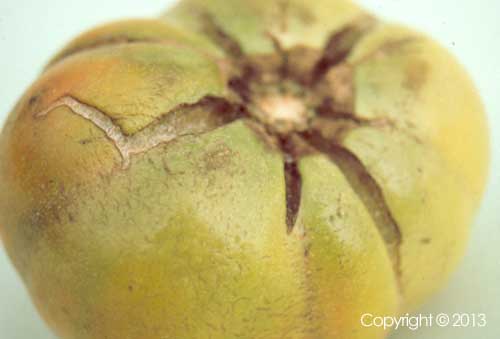
Growth cracks in greenhouse vegetable fruit
Why Tomatoes Crack Just Before Harvest – And What You Can Do About It
There’s nothing quite as disappointing as walking through a tomato field and spotting perfectly good fruit split wide open. The crop looked excellent a few days ago, harvest was just around the corner, and then a heavy rainstorm rolls through. Suddenly, tomatoes that should have been first-grade are headed for the discard pile.
Most growers have seen it happen. What’s less obvious is why it happens.
Rain often gets the blame, and not without reason. But the rain itself isn’t really the whole story. Cracking seems to occur when several things happen at the same time, and timing is everything.
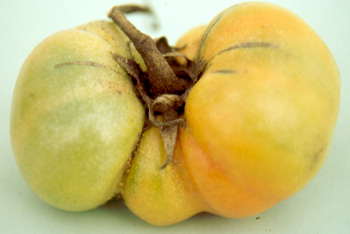
As tomatoes ripen, the skin gradually loses some of its ability to stretch. That’s a perfectly normal part of the ripening process. The trouble starts when the fruit suddenly absorbs more water than the skin can accommodate. Internal pressure builds, the skin reaches its limit, and a crack forms. In many cases, it starts around the stem and runs down the side of the fruit.
One of the biggest triggers is irrigation or rainfall after the soil has been allowed to dry out. During a dry spell, fruit growth slows. Then comes a soaking rain or a heavy irrigation, and the roots begin taking up water much more rapidly. The fruit swells in a relatively short period, but the skin simply can’t keep up.
Interestingly, water doesn’t always have to enter through the roots. Researchers have found that rainwater may also move directly into the fruit through tiny surface cracks or through the corky tissue around the stem scar. Those openings are almost impossible to see with the naked eye, yet they may allow enough water in to increase the pressure inside the fruit.
Temperature appears to play a role as well.
Anyone who has picked tomatoes on a hot afternoon knows just how warm the fruit can become. As temperatures rise, the gases and fluids inside the fruit expand. That places additional pressure on the skin. If the tomato is already close to its limit, the extra pressure may be enough to cause immediate cracking. Green fruit can behave a little differently. They may develop microscopic cracks that remain hidden for days before becoming visible as the fruit ripens.
Sunlight adds another layer of complexity. High light intensity is often associated with increased cracking, although the relationship isn’t entirely clear. Bright conditions usually encourage faster fruit growth and higher sugar concentrations1Peet, M.M.. (1992). Fruit Cracking in Tomato. HortTechnology. 2. 216-223. 10.21273/HORTTECH.2.2.216. Both have been linked with cracking in some situations, but it’s difficult to separate the effect of light from the effect of the higher fruit temperatures that usually come with it.
Then there’s the variety itself.
Some tomatoes simply crack more easily than others2Liu, Ying & Yang, Jun & Li, Zhiguo & Tchuenbou-Magaia, Fideline Laure & Liu, Yande. (2024). Investigation on the environmental causes of tomato fruit cracking and its propagation prediction in greenhouse. Journal of Texture Studies. 55. 10.1111/jtxs.12845. . Large-fruited cultivars tend to be more susceptible, especially if they have thin skins or thinner fruit walls. Fruit that loses skin strength as it begins changing colour also seems to be at greater risk. Even the amount of leaf cover can make a difference. Tomatoes exposed to direct sunlight throughout the day experience greater temperature fluctuations than fruit protected by a healthy canopy.
The good news is that growers aren’t powerless.
Probably the single most effective management practice is maintaining consistent soil moisture. That’s easier said than done in regions where summer storms are unpredictable, but avoiding cycles of very dry soil followed by heavy irrigation appears to reduce cracking considerably. Drip irrigation, combined with regular scheduling, often helps keep fruit growth steady instead of forcing sudden growth spurts.
Good calcium nutrition is another piece of the puzzle. Calcium contributes to stronger cell walls, so maintaining adequate levels may improve the fruit’s ability to withstand internal pressure. Still, calcium shouldn’t be viewed as a miracle cure. If irrigation management is poor, cracking is likely to remain a problem regardless of the fertiliser programme.
Keeping fruit cooler can also help. In open-field production, maintaining good foliage cover provides natural shade and reduces rapid heating during the hottest hours of the day. Greenhouse growers have a little more control. Avoiding large differences between daytime and night-time temperatures, while allowing temperatures to rise gradually each morning, may reduce stress on developing fruit.
Harvest timing deserves some thought too.
Once tomatoes reach the pink stage, their skins become increasingly vulnerable. Where cracking is a recurring problem, picking fruit slightly earlier may save a significant portion of the crop. It isn’t always the ideal marketing strategy, especially where vine-ripened tomatoes are preferred, but it may be a worthwhile trade-off if losses are consistently high. It has been found that the fruit load had a significant effect on fruit russetting.3Demers, Dominique-André & Dorais, Martine & Papadopoulos, Athanasios. (2007). Yield and Russeting of Greenhouse Tomato as Influenced by Leaf-to-fruit Ratio and Relative Humidity. HortScience. 42. 503-507. 10.21273/HORTSCI.42.3.503.
Of course, prevention often starts long before the first fruit sets. Choosing a cultivar with good crack resistance remains one of the most reliable ways to minimise losses. Genetics won’t eliminate cracking completely, particularly during extreme weather, but they can provide a useful buffer when growing conditions become less than ideal.
Researchers are still trying to fully understand why tomatoes crack. The process appears to involve water movement, fruit physiology, temperature, light, and genetics, all interacting with one another. That complexity probably explains why there’s no single solution that works under every set of conditions.
For now, growers are likely to get the best results by focusing on consistency. Steady irrigation, balanced nutrition, good canopy management and selecting the right variety may not stop every fruit from cracking. They do, however, stack the odds in your favour. And sometimes, in tomato production, that’s exactly what makes the difference between an average harvest and a profitable one.
References
- 1Peet, M.M.. (1992). Fruit Cracking in Tomato. HortTechnology. 2. 216-223. 10.21273/HORTTECH.2.2.216.
- 2Liu, Ying & Yang, Jun & Li, Zhiguo & Tchuenbou-Magaia, Fideline Laure & Liu, Yande. (2024). Investigation on the environmental causes of tomato fruit cracking and its propagation prediction in greenhouse. Journal of Texture Studies. 55. 10.1111/jtxs.12845.
- 3Demers, Dominique-André & Dorais, Martine & Papadopoulos, Athanasios. (2007). Yield and Russeting of Greenhouse Tomato as Influenced by Leaf-to-fruit Ratio and Relative Humidity. HortScience. 42. 503-507. 10.21273/HORTSCI.42.3.503.
Related Posts


Share This Story, Choose Your Platform!


What affects water quality in hydroponics?
The main factors affecting water quality in hydroponics are chemical, biological, and physical/environmental conditions. Maintaining optimal water quality is essential [...]
Why Water Quality Matters More Than You Think in Hydroponics
What is the ideal water quality for hydroponics. The answer is going to be very fluffy but one thing is [...]
References
- 1Peet, M.M.. (1992). Fruit Cracking in Tomato. HortTechnology. 2. 216-223. 10.21273/HORTTECH.2.2.216.
- 2Liu, Ying & Yang, Jun & Li, Zhiguo & Tchuenbou-Magaia, Fideline Laure & Liu, Yande. (2024). Investigation on the environmental causes of tomato fruit cracking and its propagation prediction in greenhouse. Journal of Texture Studies. 55. 10.1111/jtxs.12845.
- 3Demers, Dominique-André & Dorais, Martine & Papadopoulos, Athanasios. (2007). Yield and Russeting of Greenhouse Tomato as Influenced by Leaf-to-fruit Ratio and Relative Humidity. HortScience. 42. 503-507. 10.21273/HORTSCI.42.3.503.