About Antonius Lecuona

I studied agriculture at the University of Stellenbosch in South Africa in 1984 and completing my M.Sc Agric. in 1998. . My love for "Controlled Environmental Agriculture" (CEA), started in my third year when I was exposed to the Welgevallen Research Station. There Prof. P.C.Maree showed us what hydroponics consisted of. It was awesome. There were no large tractors involved, no dusty fields, no uncontrollable storms to destroy your crop (well that is what I thought). Since then I put hydroponics to much better use, not just farming. We solved pollution problems by cleaning mines effluent with hydroponics and aquaculture. They were used to remove toxic metals to produce clean water (which we sold and make more money of than the produce). What I learned from 1987 I tried to compile in this website and I hope it is from some value to the serious commercial farmer that wants to take the journey into Commercial Hydroponic Farming.

What is a chelate

2020-12-30T15:00:29+02:00By |Fertilizers, Nutrients|

The word ‘chelate’ is derived from the Greek word meaning ‘claw’. Many of the micro elements such as Fe, Mn, Cu and Zn are difficult for the plant to absorb and in some cases, deficiency symptoms may occur if these micro-elements are not made available to the plant in chelated [...]

Is your closed hydroponic farm correctly designed for stock solutions

2014-07-19T11:46:25+02:00By |Closed systems, Fertilizers, Nutrients, Systems|

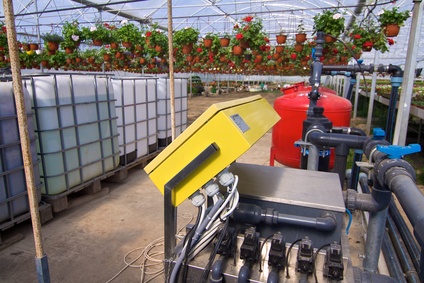
Most automated systems installed in closed hydroponic systems use injectors rather than proportioners. A simplified diagram of where to install such a system is provided below. Many advanced injectors such as the Priva® and Volmatic® systems use much more complex configurations. Most of the systems use two pH probes and [...]

Here is a quick way to make nutrient stock solutions for hydroponic systems

2014-02-15T14:01:27+02:00By |Fertilizers, Nutrients|

To make a nutrient stock solution, you need a minimum of two tanks. Nutrient Stock solutions cannot be made in one tank. The reason is that above a certain concentration, calcium reacts with sulphates and phosphates to form insoluble calcium sulphate ([latex]\ce{CaSO4}[/latex]) and calcium phosphate ([latex]\ce{Ca3(PO4)2}[/latex]). The two nutrient tanks will [...]

Go to Top